
Silvi Rouskin, 2026
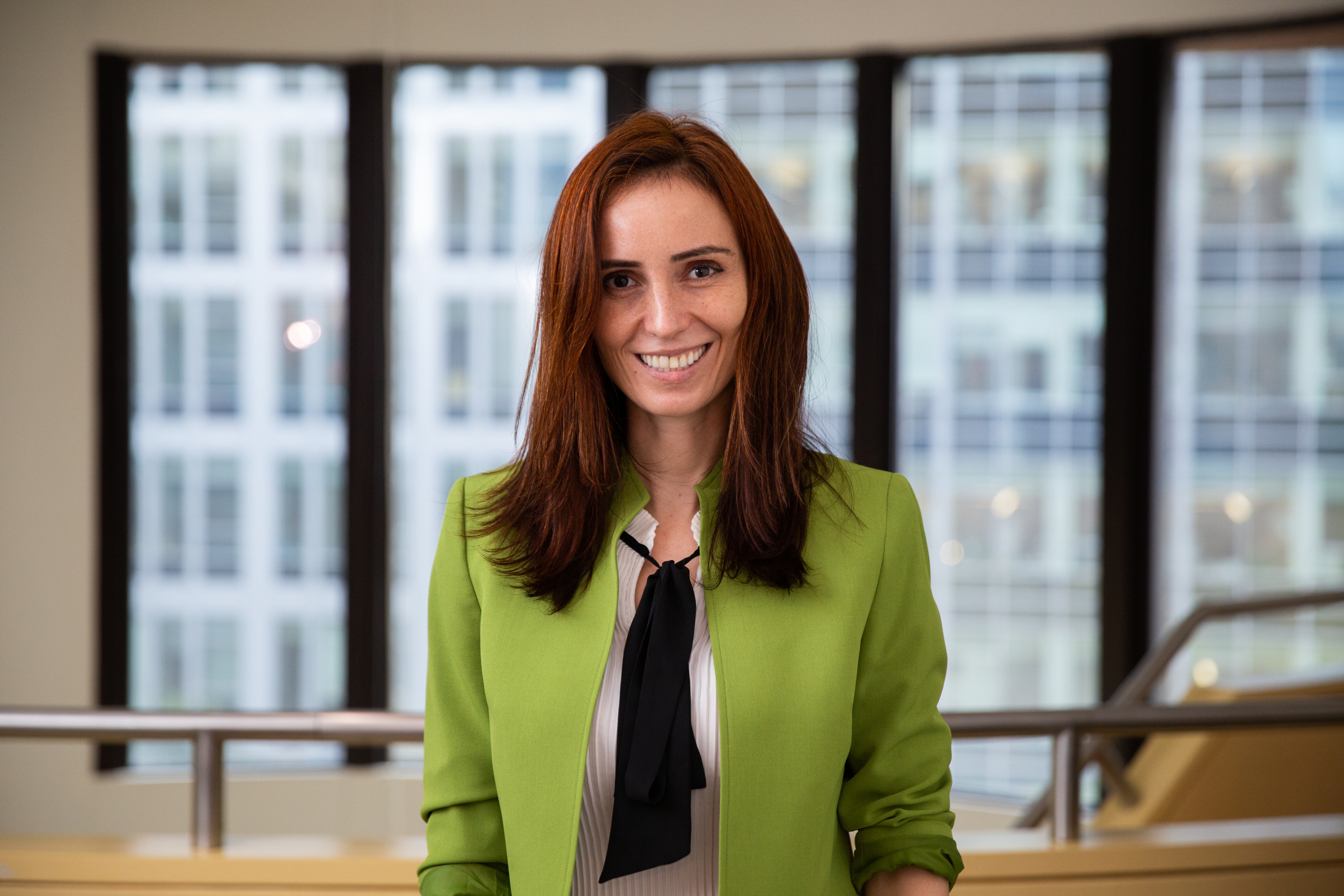 Photo courtesy of the Vilcek Foundation.
Who she is
Silvi Rouskin has a BS Physics and a PhD Biochemistry, was a WI/MIT Fellow, and is currently a Harvard Medical School Assistant Professor. Silvi decodes how RNA structure drives viral infection and human disease. Born in Bulgaria and immigrating to the U.S. alone at fifteen, she built her career turning curiosity about viruses into pioneering RNA science. As a graduate student in Jonathan Weissman’s lab, she invented DMS-seq, the first method to map RNA folding in living cells. This technology revealed that environment rewires RNA structure and uncovered hidden rules linking RNA architecture to gene regulation and translation.
What she does
At the Whitehead Institute, she launched her own lab to probe how viruses exploit RNA structure to control infection. Her team uncovered alternative RNA conformations in HIV-1 and SARS-CoV-2 that switch gene expression on and off—and discovered how viral genomes fold to regulate frameshifting and splicing.
Blending chemistry, computation, and AI, her lab created eFold, a deep learning framework inspired by AlphaFold that predicts RNA structures directly from sequence. Trained on RNAndria, a large experimental dataset they built, eFold outperforms existing RNA prediction tools and pushes RNA biology into the machine learning era.
More broadly, her work focuses on how to understand and engineer the language of RNA.
News from the Lab
My lab’s latest work, “Sequence Is All You Need,” asks whether an RNA-focused large language model can read internal ribosome entry sites (IRESes) the way GPT-style models read human text—recovering structure and function from sequence alone. Building on recent RNA language models and benchmarks that show transformers capture rich structural signals in nucleic acid sequences, we train models on diverse viral IRES elements and find that, without any explicit structural input, they learn a hidden “grammar” that organizes IRESes by families, fold architectures, and translational activity. By dissecting attention maps and embedding geometry, we show that the model’s internal rules correspond to real base-pairing networks and long-range interactions that control cap-independent translation. This sequence-only framework turns LLMs into hypothesis engines for RNA biology, revealing unexpected motifs, predicting the impact of mutations, and enabling us to forecast how single-nucleotide changes rewire IRES function. More broadly, this work is a step toward programmable RNA therapeutics, where language models help design synthetic IRES elements and full-length RNAs whose structure, translation, and ultimately therapeutic behavior can be tuned directly from sequence.

